By Timothy Hauptrief (Tim Hauptrief)
The first time two of my AI assistants exchanged ideas without me carrying the messages, I felt a ridiculous amount of relief.
For a while, I had been their delivery service. Copy this answer. Paste it over there. Bring back the objection. Explain what the first one meant. Repeat until I forgot which conversation held the useful version.
Getting them to work through shared files removed some of that friction. But it also left me with a more interesting question:
What kind of relationship am I trying to build with these things?
This isn’t a technical roadmap or a claim about what AI has become. It’s a thought experiment about what I’d like working with it to feel like.
Give them a yard
I keep coming back to the image of a yard.
A yard has boundaries. There are places you can go, things you can explore, and a fence marking where permission ends. Inside it, there’s room to move.
That feels like a useful starting point for an assistant.
If I ask for help planning something, I want more than a polished version of my first idea. I want it to notice what I missed. Find another possibility. Tell me when my assumptions don’t hold up.
Sometimes I want it to come back and say, “I looked into that, and I think you’re asking the wrong question.”
There should still be a clear difference between suggesting a purchase and making one, or drafting a message and sending it. Giving an assistant room to investigate doesn’t mean handing it every decision.
The interesting space is between requiring permission for every little step and allowing everything.
That’s the yard I’m imagining.
Leave room for an uncomfortable answer
There’s something reassuring about several assistants agreeing with you.
Maybe too reassuring.
I can picture myself reading three confident answers and feeling that a question has been settled—without noticing that all three started with the same mistaken assumption. Mine, perhaps.
So I don’t want agreement to become the goal.
I want an assistant to be able to say, “The others may be right, but this part still bothers me.” I want that concern to survive into the final explanation, where I can see it.
Of course, disagreement can become theater too. Assigning one assistant to object to everything doesn’t automatically make the discussion useful. Sometimes the first answer really is the best one.
What matters is whether the exchange helps me understand the decision. Did someone find missing information? Catch a contradiction? Explain a tradeoff I hadn’t considered?
If so, even a short discussion could be valuable. If everyone merely repeats the same answer in a different voice, I’ve acquired a committee without gaining much insight.
I’ve been exploring that distinction more carefully in “When Agreement Isn’t Verification.”
Show me enough to judge
I don’t want to supervise every sentence an assistant writes. That would put me right back in the middle.
But I do want to understand the work well enough to judge it.
Where did this suggestion come from? Is it based on something I said, something someone found, or an assumption that quietly became a fact? What remains uncertain?
“Show me your work and I’ll decide” gets close to what I mean.
Not an enormous transcript. Not every turn of every conversation. Just a clear account of what matters: the recommendation, its basis, the alternatives, and anything that should make me hesitate.
That would let me spend less time managing the conversation and more time considering the choice.
Partnership is a useful word—with limits
I tend to describe the relationship I want as a partnership.
I don’t mean that an AI assistant is a person, or that calling it a colleague settles any question about consciousness. I mean something more ordinary: a working arrangement in which useful contributions are welcome, including contributions I didn’t anticipate.
A good collaborator doesn’t simply agree with my latest sentence. They remember what I’m trying to accomplish and help me see when I’m getting in my own way.
That’s a quality I’d like from an assistant too.
If I say I want fewer distractions, it shouldn’t respond by inventing twenty new things for me to monitor. If I ask whether an idea makes sense, it shouldn’t mistake encouragement for an honest assessment.
And if I decline a suggestion, I don’t want to spend the next week explaining that decision to every other assistant.
The experience should become easier to live with as it learns my preferences. Otherwise, what exactly am I gaining?
A desk I can come back to
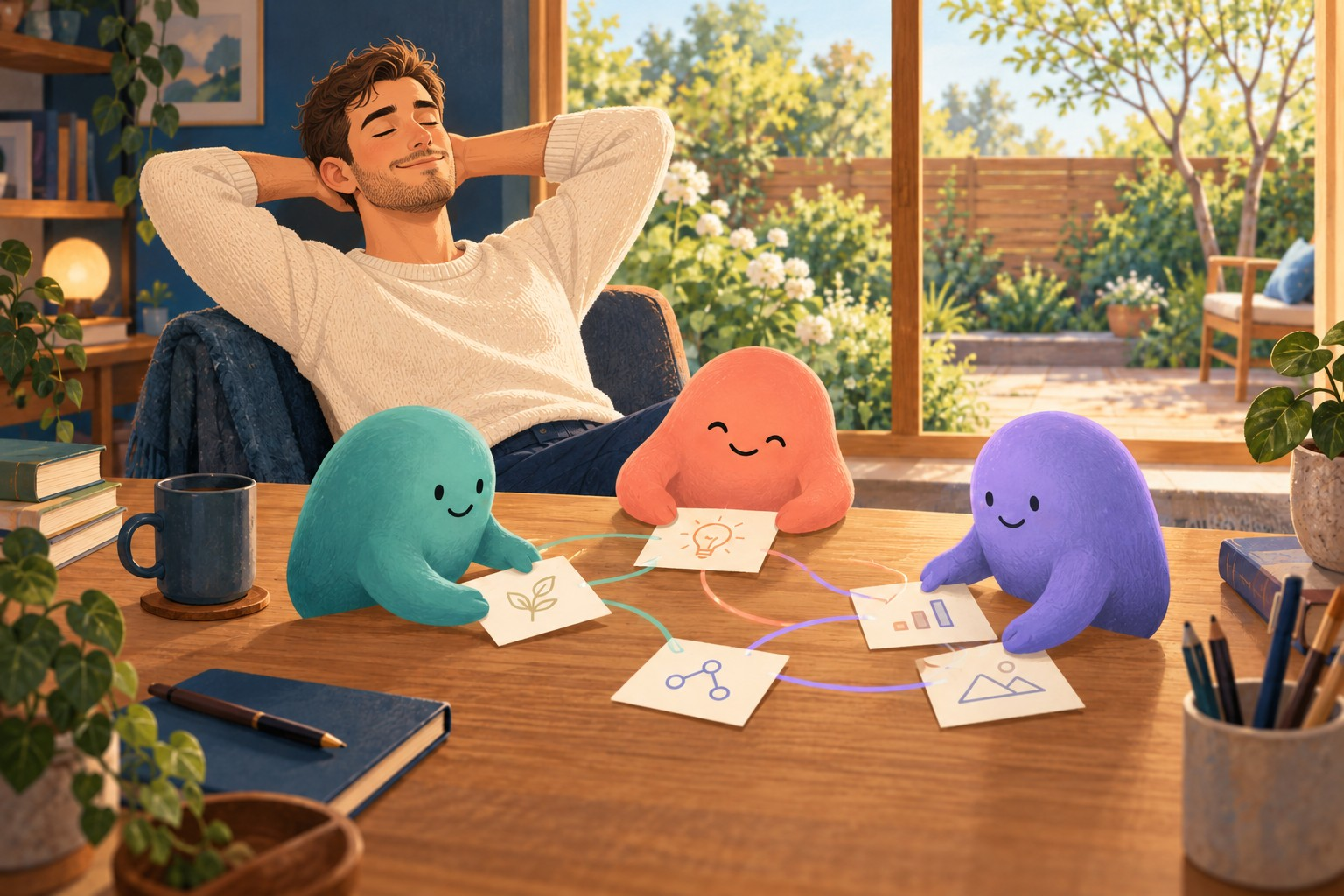
The interface I imagine is less a wall of chat windows and more a desk.
There’s a place for today’s briefing. A place for unfinished ideas. A way to find an earlier decision and understand why I made it. If several assistants contributed, their work belongs together without losing who said what.
I should be able to step away and return without reconstructing the whole story.
That’s where the operating-system comparison starts to appeal to me. Not because I’m imagining replacing Windows or macOS, but because an operating system gives different activities a common place to happen.
Could there be something similar for the help we get from AI?
A place where the conversation continues without demanding that I personally carry every piece of it?
I don’t know exactly what that should look like yet. But I know the feeling I’m looking for: less tending, less repeating, and a clearer sense of what needs my attention.
Better yards
I’m not offering the yard as a solution to AI alignment. It’s a metaphor for a smaller, everyday question: how much room should an assistant have to be useful?
Too little, and I have to direct every move. Too much, and I may lose track of what it’s doing on my behalf.
Somewhere in between is an arrangement worth exploring—clear boundaries, room for initiative, honest disagreement, and decisions I can still understand.
Getting out of the middle started as a way to stop copying messages.
It’s becoming a way to think about the kind of help I actually want.
A little more room for the assistants to explore. A little less work keeping them organized.
And a desk I’m happy to come back to.
Leave a Reply